Occupancy Grid Maps
Representing the world as a grid of free / occupied cells via log-odds.
We have covered the Kalman Filter, the Extended Kalman Filter, and briefly mentioned alternatives. Now we move to particle filters — but before we do, we introduce grid maps, an alternative to the landmark/feature representation used by the KF approaches.
This lesson covers grid maps; the next lessons cover Monte Carlo localization, FastSLAM, and grid-based SLAM.
Feature-based vs occupancy-based mapping
- Feature/landmark-based SLAM needs a front-end that detects features from the sensor feed (camera, LiDAR, …).
- Occupancy maps can be derived directly from sensor measurements (typically LiDARs) with no additional processing.
Features / landmarks
- Natural choice for Kalman-Filter–based systems.
- Compact representation.
- Multiple observations of the same landmark improve its position estimate (EKF).
- Requires a reliable feature detector.
Grid maps
- Discretize the world into cells.
- Each cell is assumed to be occupied or free.
- Non-parametric model.
- Large maps require substantial memory.
- Do not rely on a feature detector.
Assumptions
Each cell is a binary random variable modelling occupancy:
- Occupied:
- Free:
- No knowledge:
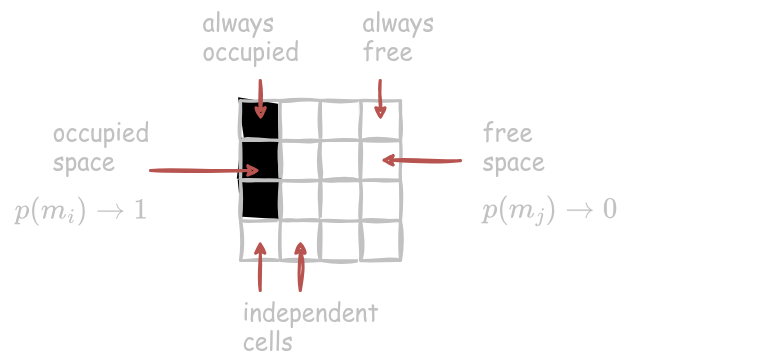
- Binary cell state. The area corresponding to a cell is either completely free or occupied.
- Static world. The world is static — cells don't change once observed.
- Cell independence. Cells are independent random variables.
Note. Cell independence is a convenient approximation, not a faithful property of real environments. Occupancy is spatially correlated (a wall is a long surface), but assuming independence keeps updates factorized and online — one Bayes / log-odds update per cell.
Representation
The map distribution is the product over the cells:
Given sensor data and known poses , we estimate:
where is a binary random variable. We use a Bayes filter per cell — simpler than the full Bayes filter because the world is static, so there is no prediction step.
↳ This is the binary Bayes filter for static state.
Static-state binary Bayes filter (derivation)
Start by applying Bayes' rule to the cell posterior:
Apply the Markov assumptions:
- Knowing where the robot will be in the future gives no extra information about a current cell:
- Given the cell state, past observations don't help predict the current one:
Eq. (1) becomes:
Now flip the likelihood by applying Bayes' rule again:
Substitute (3) into (2), and assume that without an observation the pose alone tells us nothing about the cell — :
Doing the same thing for (cell is free) gives a symmetric expression. Dividing the two cancels the messy normalizers and :
Three clean factors — a fresh-measurement term, a recursive term, and a prior. We can invert the ratio to recover the probability:
In practice we run the update in log-odds — products turn into sums, no exponentials.
Log-odds notation
Define the log-odds:
Recover the probability via .
The occupancy update becomes additive:
Or in shorthand:
Occupancy grid mapping algorithm
- for all cells m_i:# loop over cells
- if m_i is in the perceptual field of z_t:# cell in perceptual field?
- ℓ_{t,i} = ℓ_{t-1,i} + inv_sensor_model(m_i, x_t, z_t) − ℓ_0# log-odds update
- else:# otherwise
- ℓ_{t,i} = ℓ_{t-1,i}# leave unchanged
- return {ℓ_{t,i}}
Inverse sensor model (laser range finder)
The inverse sensor model turns a single LiDAR beam into per-cell occupancy evidence. It supplies the term needed by the log-odds update, converting one ray into many local map updates.
Inputs (per beam): measured range , beam direction, grid geometry. Outputs (per touched cell): a probability (or log-odds increment) that the cell is occupied.
Physical encoding:
- Free before the hit. Cells with distance are pushed toward free with probability .
- Hit window. Cells in the thin window are marked occupied with probability .
- Beyond the hit. For we provide no information and keep the prior .
The window width (typically 1–3 cell widths) absorbs range/bearing noise and grid discretization so observed surfaces leave a stable, thin footprint.
Piecewise definition (per cell at distance along the ray):
- Max-range case. If the beam returns no hit, apply free-space evidence up to ; beyond keep the prior.
- Independence. Each touched cell is updated independently; ray-casting decides which cells are touched. Convert probabilities to log-odds increments with , then apply the standard update.
import numpy as np

def p_occ_step(s_i, z, r, p_free, p_prior, p_occ):
    """Inverse sensor model with a step window."""
    left  = z - r / 2.0
    right = z + r / 2.0
    if s_i < left:
        return p_free
    elif s_i <= right:
        return p_occ
    else:
return p_priorDrag the sliders to see how the inverse sensor model's piecewise profile depends on the measured range and the window width. Cells inside the hit window are pushed toward p_occ; cells before it are pushed toward p_free; cells beyond the hit stay at the prior 0.5.
This interactive map shows the algorithm running: the rotating LiDAR beam on the left builds up the log-odds occupancy map on the right via the inverse-sensor-model update. As the robot walks around (or you click to teleport it), more cells get pushed toward 0 (free, white) or 1 (occupied, black); unobserved cells stay at the prior grey.
Summary
- Occupancy grid maps discretize space into independent cells.
- Each cell is a binary random variable estimating whether the cell is occupied.
- We run a static-state binary Bayes filter per cell.
- Mapping with known poses is easy.
- The log-odds representation makes the update additive and fast.
- No need for pre-defined features.
Incremental scan alignment (bonus)
Trying to make an occupancy map from raw odometry doesn't work well in practice.
- Motion is noisy; we can't ignore it.
- Assuming known poses fails.
- Often the sensor is more precise than the odometry.
- Scan matching incrementally aligns two scans, or a scan to a map, without revisiting the past.
Pose correction via scan matching (MAP):
Common realizations: ICP, scan-to-scan, scan-to-map, map-to-map, feature-based, RANSAC for outlier rejection, correlative matching.
Reading material
Static-state binary Bayes filter
- Thrun, Burgard, Fox. Probabilistic Robotics, §4.2.
Occupancy grid mapping
- Thrun, Burgard, Fox. Probabilistic Robotics, §9.1–9.2.