Landmark Graph-based SLAM
Joint pose + landmark graphs and information-matrix sparsity.
Recap
- Use a graph to represent the SLAM problem.
- Every node in the graph corresponds to a pose of the robot during mapping.
- Every edge between two nodes is a spatial constraint between them.
Graph-based SLAM: build the graph and find a node configuration that minimizes the error introduced by the constraints.
The graph
So far:
- Vertices: robot poses .
- Edges: virtual observations (transformations) between robot poses.
This lesson's topic: how to deal with landmarks?
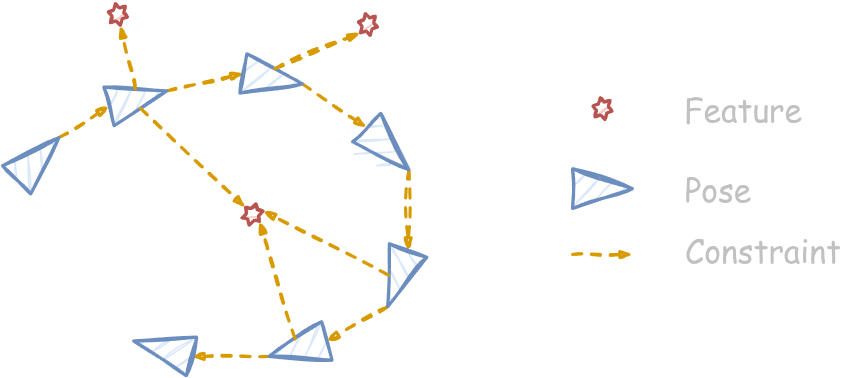
The graph with landmarks
Nodes can now represent:
- Robot poses,
- Landmark locations.
Edges can represent:
- Landmark observations,
- Odometry measurements.
The minimization now optimizes both the landmark locations and the robot poses.
2D landmarks
A landmark is a point in the world. A relative observation is also in .
Landmark observation
Expected observation (using an sensor):
- — rotation matrix of robot pose .
- — robot translation.
- — landmark position.
Error function:
Bearing-only observations
In many real-world scenarios, sensors don't provide range information — only bearing (direction) of a feature relative to the robot:
- Cameras — a visual feature can be detected in the image plane, but its actual distance is unknown without additional geometric reasoning or motion.
- Directional antennas — measure direction to a source but not range.
- Monocular SLAM — a single camera setup can only estimate bearing; depth is inferred gradually through motion (triangulation).
The robot observes only the bearing toward the landmark, but the landmark itself is still a 2D point.
Expected observation with a bearing-only sensor:
Error function:
Where is the robot?
If the robot observes one landmark, the robot can be anywhere on a circle around the landmark — a 1D solution space, constrained by distance and orientation.
How many 2D landmark observations are needed to fully resolve the pose? → At least two.
If the robot observes one landmark bearing-only, the robot can be anywhere in the XY-plane — a 2D solution space, constrained by the robot's orientation.
How many bearing-only observations are needed to resolve a pose? → At least three.
The rank of the matrix
In landmark-based SLAM, the system can be under-determined:
- The rank of is less than or equal to the sum of the ranks of its constraints.
- To determine a unique solution, must have full rank.
Under-determined systems
There's no guarantee of a full-rank system:
- Landmarks may be observed only once.
- The robot might lack odometry.
We handle these cases by adding a damping factor to . Instead of solving , we solve
Effect of the damping factor :
- Makes the system positive definite.
- Acts as a weighted combination of Gauss-Newton and steepest descent → Levenberg-Marquardt.
- Stabilizes convergence and avoids large steps.
Switch to Pose + landmarks to see the four-block H structure used by landmark-based graph SLAM: a dense block for the pose-pose part (top-left), a sparse near-diagonal block for the landmark-landmark part (bottom-right), and the cross-blocks linking poses to the landmarks they observed. This block sparsity is what makes the Schur complement trick so effective in bundle adjustment — eliminate the landmark block, solve for poses, then back-substitute.
A working example: 2D pose-landmark graph with Levenberg-Marquardt
The notebook walks through a full 2D pose-landmark SLAM example: noisy odometry, loop closures, and range-bearing landmark observations are folded into a single non-linear least-squares problem solved with Levenberg-Marquardt.
The pipeline is:
- Synthetic world (clean reference). Sample poses on a circle (closed loop, first pose at the origin) and scatter landmarks around the trajectory.
- Graph construction.
- Odometry edges connect with a relative motion in the local frame.
- Loop-closure edges connect to inject long-baseline constraints and reduce drift; add to close the loop.
- Landmark edges connect pose to landmark with a range-bearing measurement for visible landmarks (within max range / FOV).
- Measurement noise. Perturb odometry with Gaussian noise in translation/rotation and landmark measurements with Gaussian noise in range/bearing. The optimizer sees only these noisy factors.
- Initial guess.
- Poses: integrate noisy odometry forward from node 0; accumulates drift around the loop.
- Landmarks: back-project the first observation of each landmark from the current pose estimate.
- Levenberg-Marquardt optimization.
- Residuals:
- Pose-pose: with angle wrapping.
- Pose-landmark: , with from the current .
- Linearization: form analytic Jacobians for both factor types and accumulate the normal equations .
- Gauge fixing: add a strong prior on pose 0 (position and yaw) to define a reference frame.
- LM damping: solve . If the trial decreases the total cost, accept and reduce ; otherwise reject and increase . Iterate until convergence.
- Residuals:
import numpy as np

def wrap(a):
    return (a + np.pi) % (2 * np.pi) - np.pi

def R2(theta):
    c, s = np.cos(theta), np.sin(theta)
    return np.array([[c, -s], [s, c]])

def relative_pose(xi, xj):
    """Predicted odometry z_ij from poses xi -> xj (both 3-vectors)."""
    RiT = R2(xi[2]).T
    dt  = RiT @ (xj[:2] - xi[:2])
    dth = wrap(xj[2] - xi[2])
    return np.array([dt[0], dt[1], dth])
The full implementation — including Jacobians for both factor types, the LM accept/reject loop, gauge fixing via a strong prior on pose 0, and the convergence plots — is in notebooks/3_graph_based/3_landmark_graph_slam.ipynb.
Bundle adjustment
Bundle adjustment is the classical least-squares problem from computer vision. It jointly optimizes camera poses (extrinsics), sometimes intrinsics, and 3D point positions so that projected points best match observed image features.
- 3D reconstruction from images taken from different viewpoints.
- Minimizes the reprojection error.
- Typically solved with Levenberg-Marquardt.
- Developed in photogrammetry during the 1950s.
The structure is identical to landmark-based graph SLAM: poses + landmark (3D point) variables, with sparse cross-blocks linking the pose a landmark was seen from to the landmark itself. The Schur complement is the standard trick to factor out the landmark block efficiently.
Summary
- Graph-based SLAM extended to handle landmarks as graph nodes.
- The rank of matters — under-determined systems need extra constraints or damping.
- Levenberg-Marquardt is the workhorse optimizer: trust-region damping plus accept/reject step control gives a robust algorithm.
- Bundle adjustment is structurally the same problem; sparsity keeps it tractable at scale.